Myrdal: a change on the high plateau
A station with no road, high on the mountain edge between Oslo and Bergen, where the main line meets the steep branch down to Flåm and the fjord.
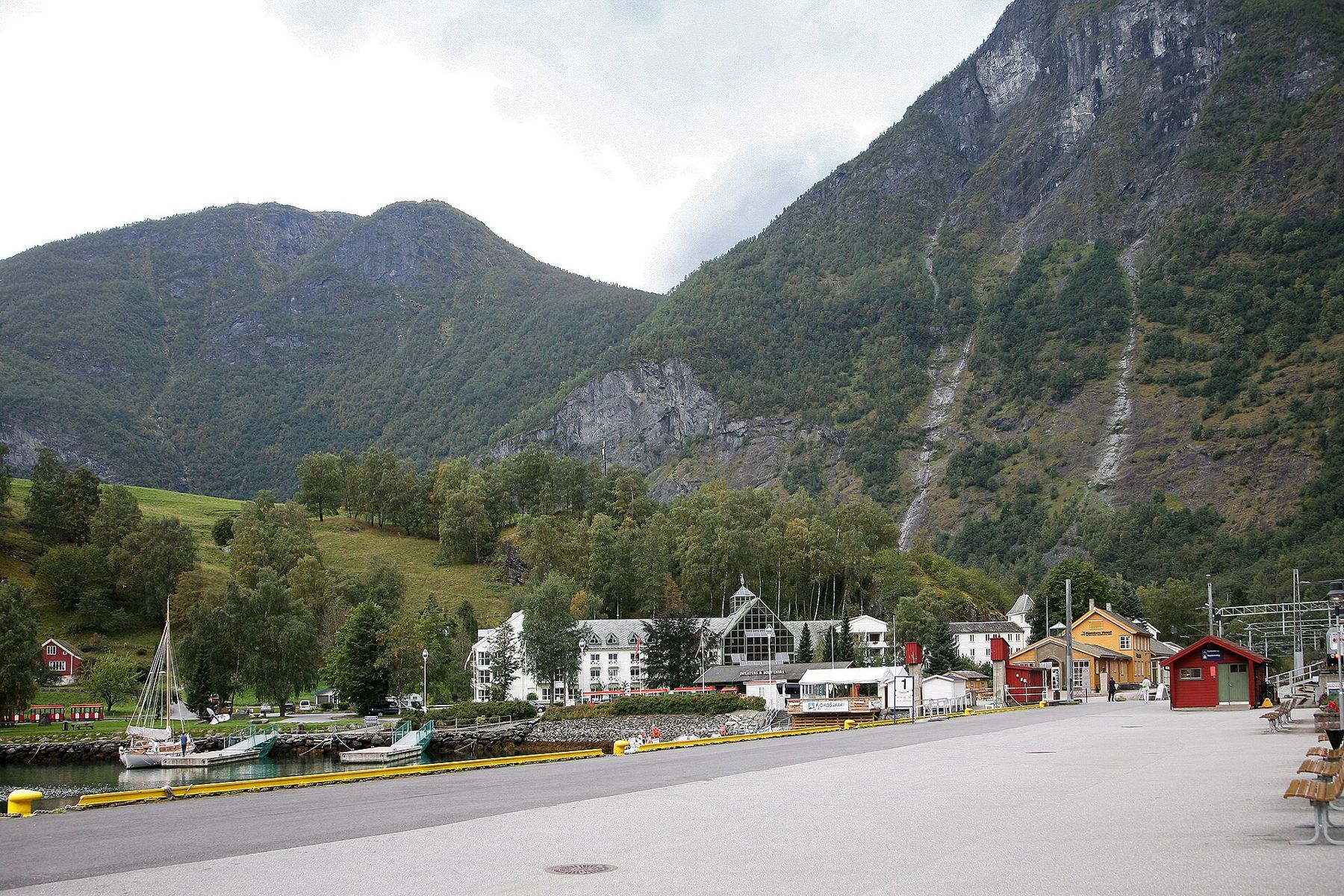
i
Photo by W. Bulach · CC BY-SA 4.0
Myrdal is the kind of station that exists only because of the railway. It stands at the edge of the high mountain plateau between Oslo and Bergen, a little under 900 metres above sea level, with a few railway buildings, a platform and a wide view down into the valley. There is no road. You arrive by train, on foot or by bicycle, and you leave the same way. For most travellers it is the place where the Bergen Line hands over to the Flåm Line, the short branch that drops down the mountainside to the head of the Aurlandsfjord.
Where the main line meets the branch
The Bergen Line is Norway's main east–west railway, crossing the mountains from Oslo to Bergen. It is the national railway's long-distance route over the plateau, and its trains call at Myrdal on the way. The Flåm Line starts here. Its trains wait at their own platform beside the main line, and the change is a short walk along the station rather than a trek between buildings.
From Oslo, the journey to Myrdal takes roughly four and a half to five hours, climbing out of the lowland forests, past lakes, and up onto the open plateau around Finse, near the highest point on the line. From Bergen, it is about two hours. The Flåm Line then takes about an hour to cover the twenty kilometres down to Flåm. Timetables vary by season, and in winter there are fewer trains on the branch, so check the current timetable for both lines before you build a day around the connection.
For the whole journey from Denmark to the fjord, see Copenhagen to Flåm.
Snow, wind and a short day
Myrdal is exposed. Even in summer the air at the station can be cold, and in poor weather the cloud sits low on the plateau. From autumn to late spring there is snow on the ground, sometimes deep, and the snow sheds and fences you see along the Bergen Line are there because the line has to be kept open through conditions that close roads. Winter crossings are part of the appeal: the plateau white to the horizon, the train cutting through drifts. They also mean delays are possible, and the Bergen Line can occasionally be disrupted by storms.
If you are changing in winter, think about daylight. The days in Norway are short in December and January, and much of the descent to Flåm is worth seeing, so plan the connection for the middle of the day if you can. Keep a warm layer with you rather than packed away; the platform at Myrdal is not a place to stand around in thin clothes.
Twenty kilometres down to the fjord
The Flåm Line is one of the steepest standard-gauge railways in the world worked without a rack, dropping from Myrdal to almost sea level at Flåm. It was built through very hard terrain and opened in the early 1940s, and much of it runs through tunnels, along ledges and around hairpin bends in the valley of the Flåmsdalen. The train moves slowly, braking hard on the steep sections, and the views come in bursts between tunnels: waterfalls, steep valley walls, farms on narrow shelves of land, and finally the green floor of the valley opening out towards the fjord.
E Change here forCopenhagen to Flåm: two capitals and a fjordTwo days, comfortablySeats on either side have good moments, because the line twists back and forth so often. Many carriages have windows that open, and in summer the train is busy, so you may find yourself standing for part of the way. If views matter to you, board early at Myrdal rather than waiting on the platform for the crowd to thin.
The stop at Kjosfossen
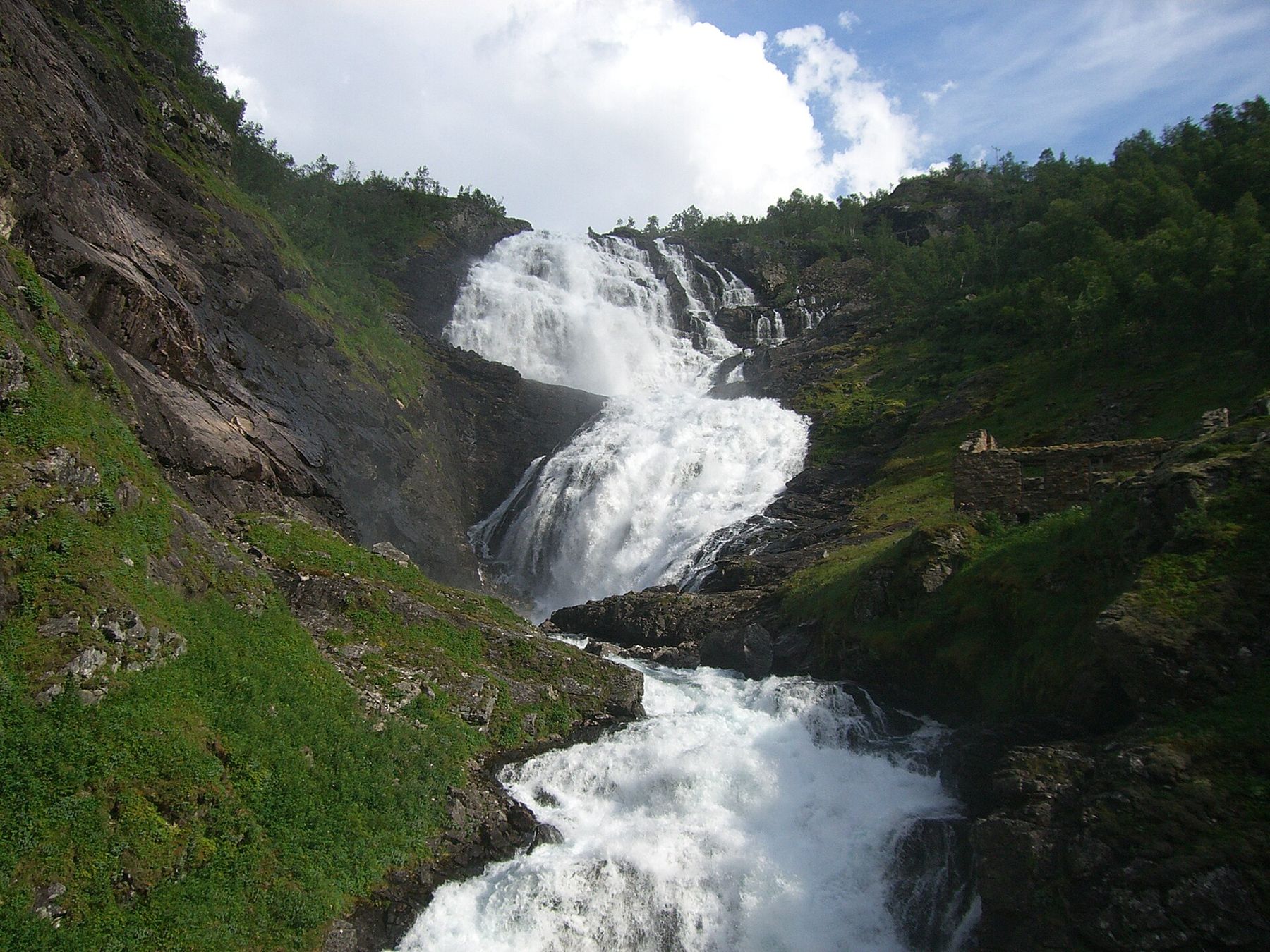
i
Photo by positivesustainability · CC BY 2.0
Partway down, the line passes the Kjosfossen waterfall, and in the main season the trains usually stop beside it for a few minutes so that passengers can step onto a viewing platform. The spray reaches the platform when the water is high, and the noise is enough to drown out conversation. The stop is part of the summer timetable rather than a fixed promise, and outside the season the train may pass without stopping. Stay close to the door and listen for the signal to reboard: the stop is brief.
The Rallarvegen on foot or by bicycle
Myrdal is also on the Rallarvegen, the old construction road built for the workers who laid the Bergen Line across the mountains. Today it is a route for walkers and cyclists, running across the plateau from the Haugastøl and Finse area and down past Myrdal towards Flåm. It is usually free of snow only from around July into September, and the opening of the higher stretches depends on how much snow fell in the winter, so check conditions before you plan a ride.
The section below Myrdal is steep, with tight hairpin bends down the mountainside, and many cyclists choose to walk their bikes on the worst of it. Below the hairpins the road eases and follows the valley floor down to Flåm, often within sight of the railway. A popular plan is to take the Bergen Line to Finse or Myrdal, ride or walk down, and pick up the train or the fjord at Flåm. Bicycles can be carried on many trains, but space is limited and rules change from season to season, so check before you travel and arrive early on busy days.
Making the change work
- Leave yourself a margin. The main-line train can lose time on the plateau, and if the last Flåm train has gone there is no road out of Myrdal.
- Check what your ticket covers. A ticket on the Bergen Line does not automatically include the Flåm Line, which is often priced and sold separately.
- In summer, expect a crowd at the change. A large part of a busy main-line train may be heading for the branch, and the platform fills quickly.
- Passenger rights in Norway follow Norwegian rules, which are not the same as those inside the EU. See through tickets and missed connections for the general picture.
- Keep your bags small if you can. The Flåm trains have limited luggage space, and the walk along the platform is easier with something you can lift. More on that in luggage, seats and the walk between platforms.
Myrdal itself rewards a few minutes of attention between trains. Walk to the end of the platform, look down the valley, and you can see the line you are about to take, folded into the mountainside far below.