Changing trains at Hamburg Hauptbahnhof
Hamburg's main station is one of the busiest in Germany and the hinge of every journey north to Denmark. It is crowded, it is noisy, and it works, once you know its layout.
i
Photo by Ad Meskens You are free to use this picture for any purpose as long as · CC BY-SA 4.0
Hamburg Hauptbahnhof is one of the busiest railway stations in Germany, and one of the busiest in Europe. Long-distance trains from the west, south and east all pass through it, and it is the main gateway to Denmark and Scandinavia. On Line C from Amsterdam to Copenhagen, this is where the journey turns north. It is a station that rewards a little preparation.
The great hall and the tracks below
The station opened in the early twentieth century, and its main feature is a vast steel and glass hall that spans the tracks. The platforms lie below street level, in a cutting, and the hall rises over them. From the walkways above, you look down on the trains and the crowds on the platforms below.
Around the hall, the station is part of the city's daily traffic. U-Bahn and S-Bahn lines stop in their own platforms beneath and beside the main station, buses gather on the streets outside, and the main shopping streets of the city centre begin a short walk to the west. People pass through on their way to work as much as to trains, and at peak times the crowd is thick. It is a station to move through with purpose rather than to wander.
The layout is simpler than it looks. The platforms run north to south. At each end of the hall, a broad walkway crosses over the tracks, with stairs, escalators and lifts down to each platform. The northern walkway, lined with shops and food stands, is usually the more crowded of the two. If you only need to cross, the other is often quicker.
Walking between platforms
To change trains, go up from your platform to one of the walkways, cross to the platform you need, and go down again. With luggage, the lifts are the slowest part: they are small and in demand. Escalators are faster if you can manage your bags on them.
- Check the platform on the departure boards as soon as you arrive. Platforms can change at short notice.
- Look at the platform sector boards, which show where each coach of your train will stop. Long-distance trains can be very long, and walking the length of the platform with bags takes time.
- The station is busiest at rush hours and at weekends, especially on Friday afternoons.
If your train is cancelled or very late, the travel centre in the station can help you rebook, and staff on the platforms can point you to replacement trains. Queues at busy times can be long, so it is worth checking the alternatives on the departure boards first.
Change here forBasel: one city, three railwaysTen to twenty minutes between stationsWhere the northbound trains go
Trains north from Hamburg go to Kiel, Flensburg and Denmark, and to Lübeck and the Baltic coast. Some start at the Hauptbahnhof, while others begin at Hamburg-Altona, a separate station west of the city centre. Your ticket and the timetable show the station; check it before you plan the change, because the two are not interchangeable at a glance.
Hamburg-Altona and the Hauptbahnhof are linked by S-Bahn and regional trains in roughly ten minutes. Hamburg Dammtor, a smaller station near the Alster lakes, also sees some long-distance trains.
The route north to Denmark currently runs through Jutland, by Flensburg and the Little Belt. The shorter route across the Fehmarn Belt is affected by long-term construction, and through trains do not currently use it; see the Fehmarn Belt crossing and check the current timetable before you travel.
An hour, or a night
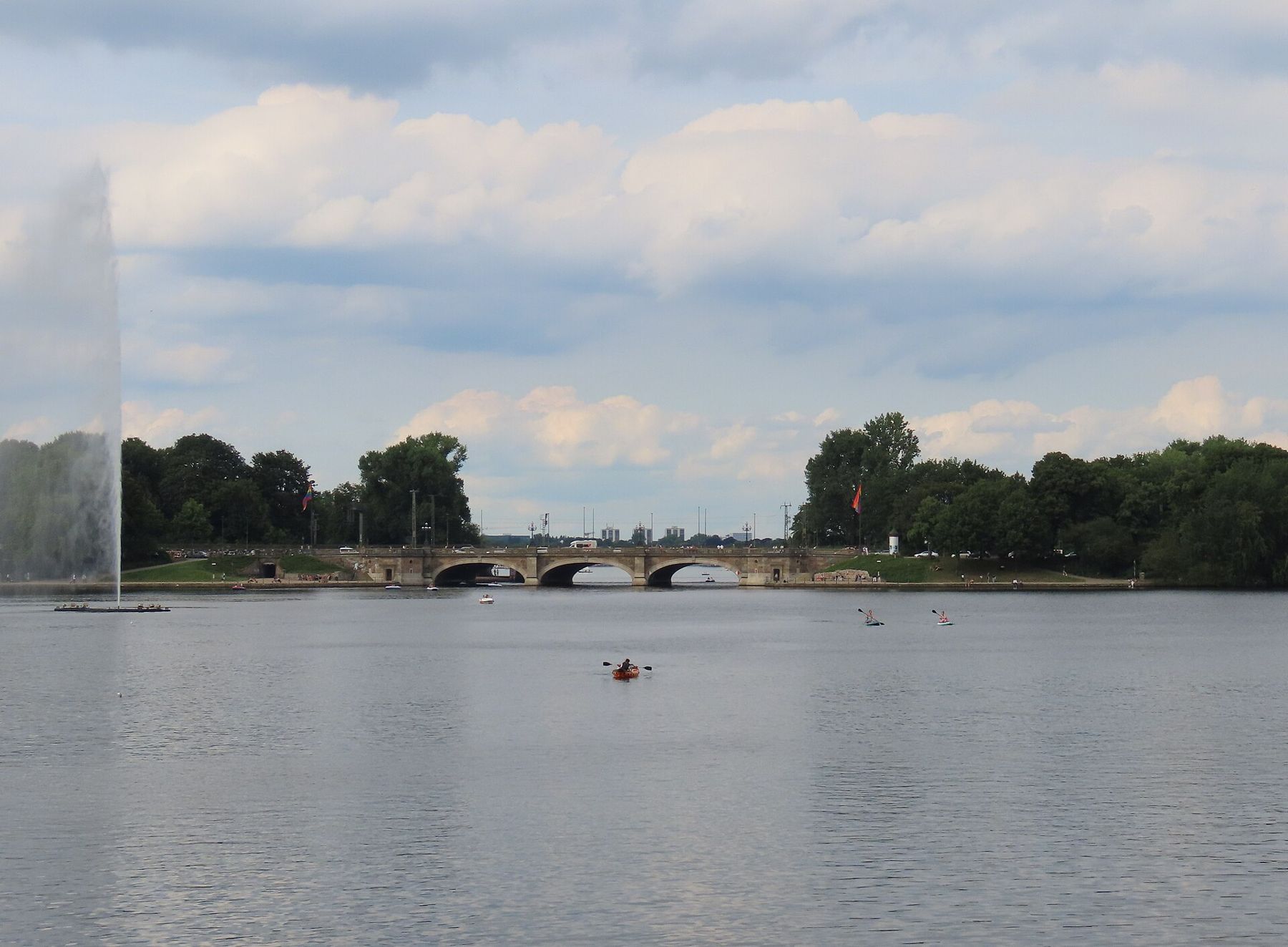
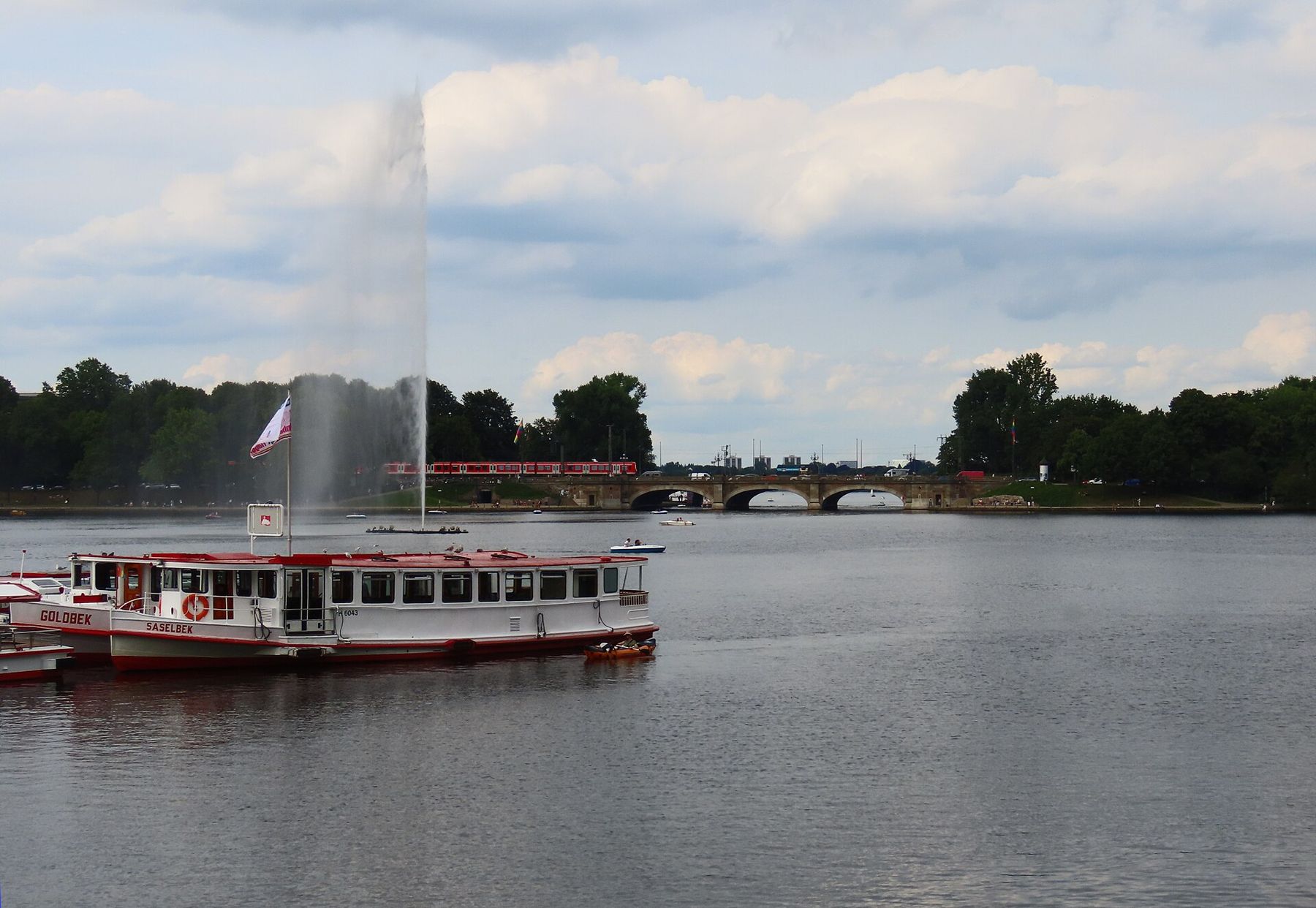
If you have an hour between trains, the Binnenalster, the smaller of the two Alster lakes, is about ten minutes' walk from the station. The Jungfernstieg, the promenade along its southern edge, is a good place to sit with the water in front of you before going back for your train. Look across the lake and you will see trains crossing the Lombardsbrücke, the stone bridge that divides the Binnenalster from the larger Aussenalster, on their way between the Hauptbahnhof and Dammtor.
i
Photo by Ad Meskens You are free to use this picture for any purpose as long as · CC BY-SA 4.0
With a night, Hamburg is a city worth exploring. It is built on water: the Alster lakes in the centre, the canals running through the old town, and the Elbe with its port.
The harbour and the Speicherstadt
The Speicherstadt, the old warehouse district by the harbour, is a grid of red-brick warehouses built on oak piles along canals, with bridges between them. Together with the neighbouring Kontorhaus district, it is a UNESCO World Heritage site. It is a short walk or U-Bahn ride from the station.
Beyond it, the Landungsbrücken piers on the Elbe look out over the working port: container ships, cranes, dry docks. The harbour ferries that leave from here are part of the city's public transport, and a ride on one is an inexpensive way to see the port from the water. At the western end of the HafenCity, the Elbphilharmonie concert hall rises above an old warehouse, with a public viewing plaza that looks across the city and the river.
Making the change work
Hamburg is a station where things can go wrong in small ways, and where it is worth planning for them.
- Trains arriving from the west and south often run late. Leave at least an hour for a change, more if your next train is the last of the day.
- Through tickets protect your connection if the first train is late; separate tickets do not. See through tickets and missed connections.
- Food and drink are easy to find in the station, and worth buying before a long northbound leg.
Once you know the layout, Hamburg Hauptbahnhof is easier than its crowds suggest. Two walkways, a row of platforms below, and a city of water outside the doors.