Amsterdam to Copenhagen, with or without the sea
Line C crosses the north German plain to Hamburg, then turns north to Denmark by bridge and belt. The sea route across Fehmarn is in flux while the tunnel is built; check before you plan around it.
i
Photo by Alchemist-hp · CC BY-SA 3.0
Line C is the long line on this map. It runs from Amsterdam across the Netherlands and the north German plain to Hamburg, then north through Schleswig-Holstein into Denmark and across two straits to Copenhagen. It is a full day of travelling, often around twelve hours, with at least one change and usually two. The country is mostly flat, and the interest is in the waterways: canals, rivers, a sea canal, two belts and the bridges over them.
East from Amsterdam to Osnabrück
Trains from Amsterdam Centraal towards Germany head east across the Netherlands through Amersfoort and Hengelo, crossing the border near Bad Bentheim. Some go on to Berlin, and travellers for Hamburg typically change at Osnabrück or Hannover; a few departures may run through to Hamburg. Check the combination for your date: the pattern of through trains and connections has changed several times in recent years.
Osnabrück Hauptbahnhof is a station with a quirk. Two lines cross here at different levels, with platforms at right angles to each other, so a change can mean a walk, some stairs, and a look at the signs. It is usually manageable within a short connection, but do not cut it fine with heavy bags.
North of Osnabrück the train runs on to Bremen and then across the Weser and the Elbe marshes into Hamburg. This stretch takes roughly two hours and passes through flat green farmland, much of it lower than the rivers beside it.
i
Photo by Flocci Nivis · CC BY 4.0
Hamburg, the hinge of the journey
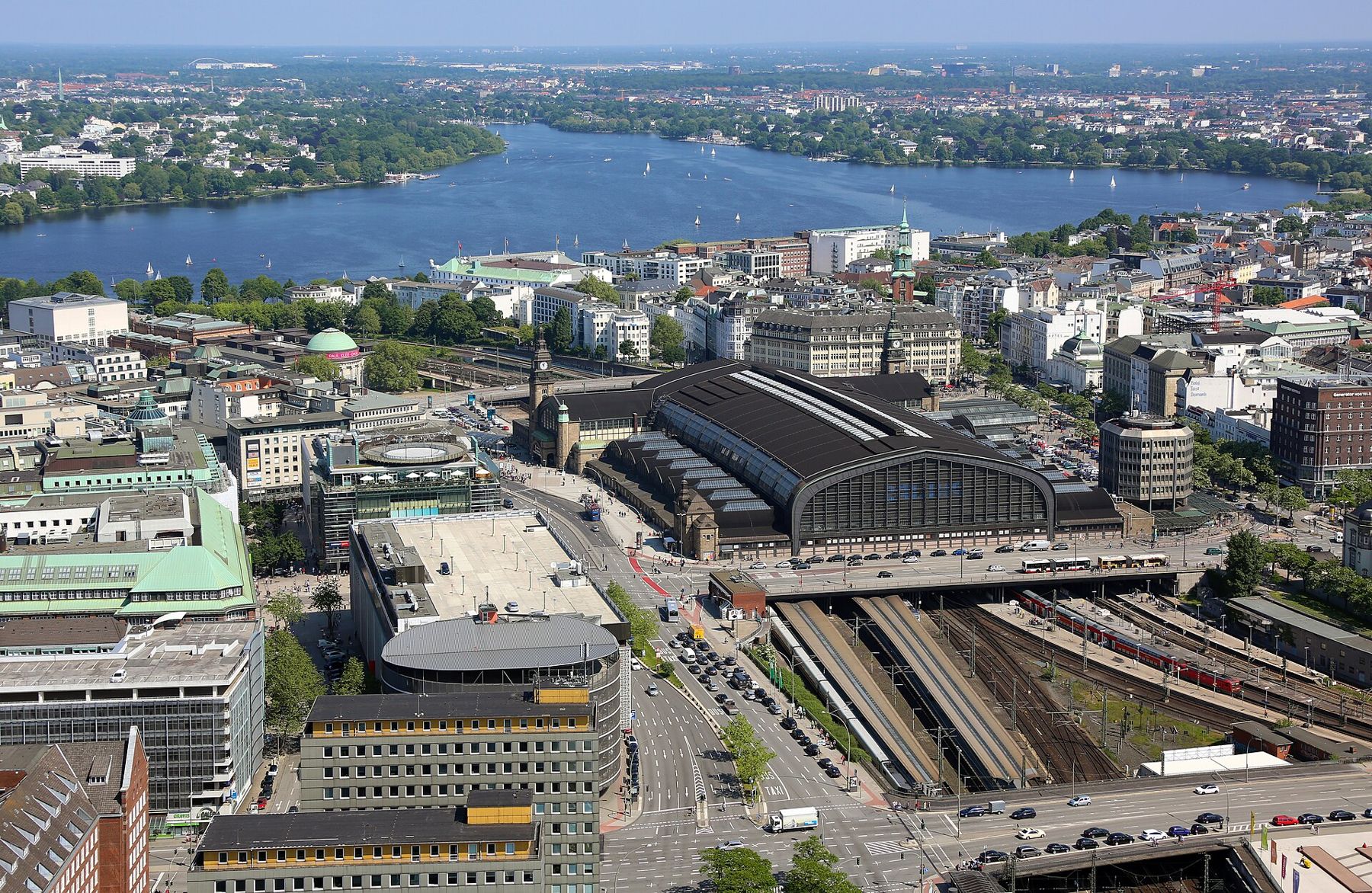
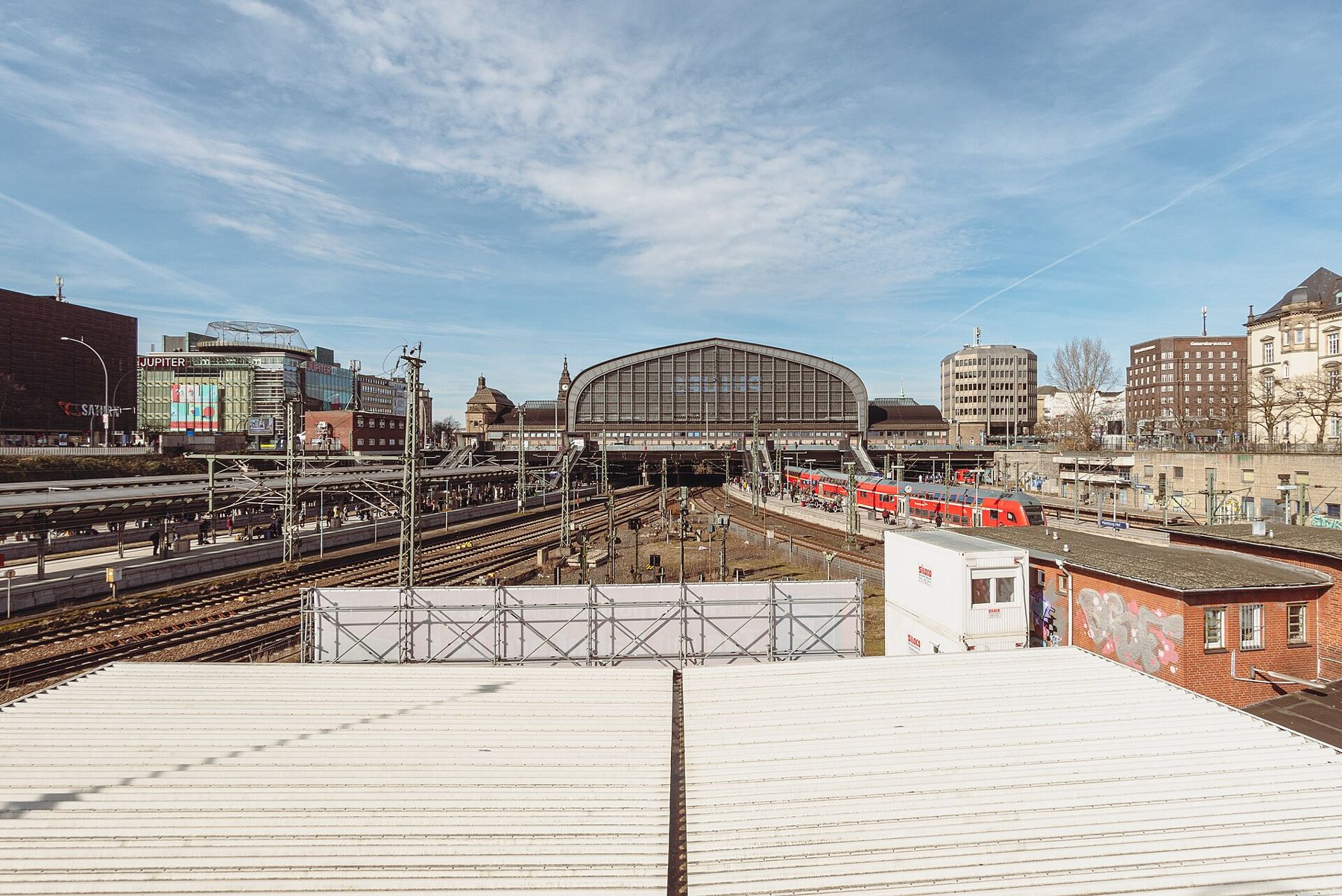
Everything on Line C turns on Hamburg. Trains from the west and south arrive here, and northbound trains to Denmark start from here or from Hamburg-Altona on the other side of the city centre. Check which station your Danish train uses. Changing at Hamburg Hauptbahnhof has its own page, but the short version is this: the platforms lie below a great steel-and-glass hall, the walkways across the tracks are crowded, and you should allow at least an hour.
If you can, break the journey here for a night. Hamburg is a city of water, built around the Alster lakes and the port on the Elbe, and a night here turns a punishing day into two easy ones.
North by Flensburg and round Jutland
The main route north from Hamburg runs through Neumünster and Rendsburg, where the train crosses the Kiel Canal on a high steel bridge, then on to Flensburg near the Danish border. The line crosses into Denmark at Padborg, where Danish police sometimes check documents on the train. Carry your passport.
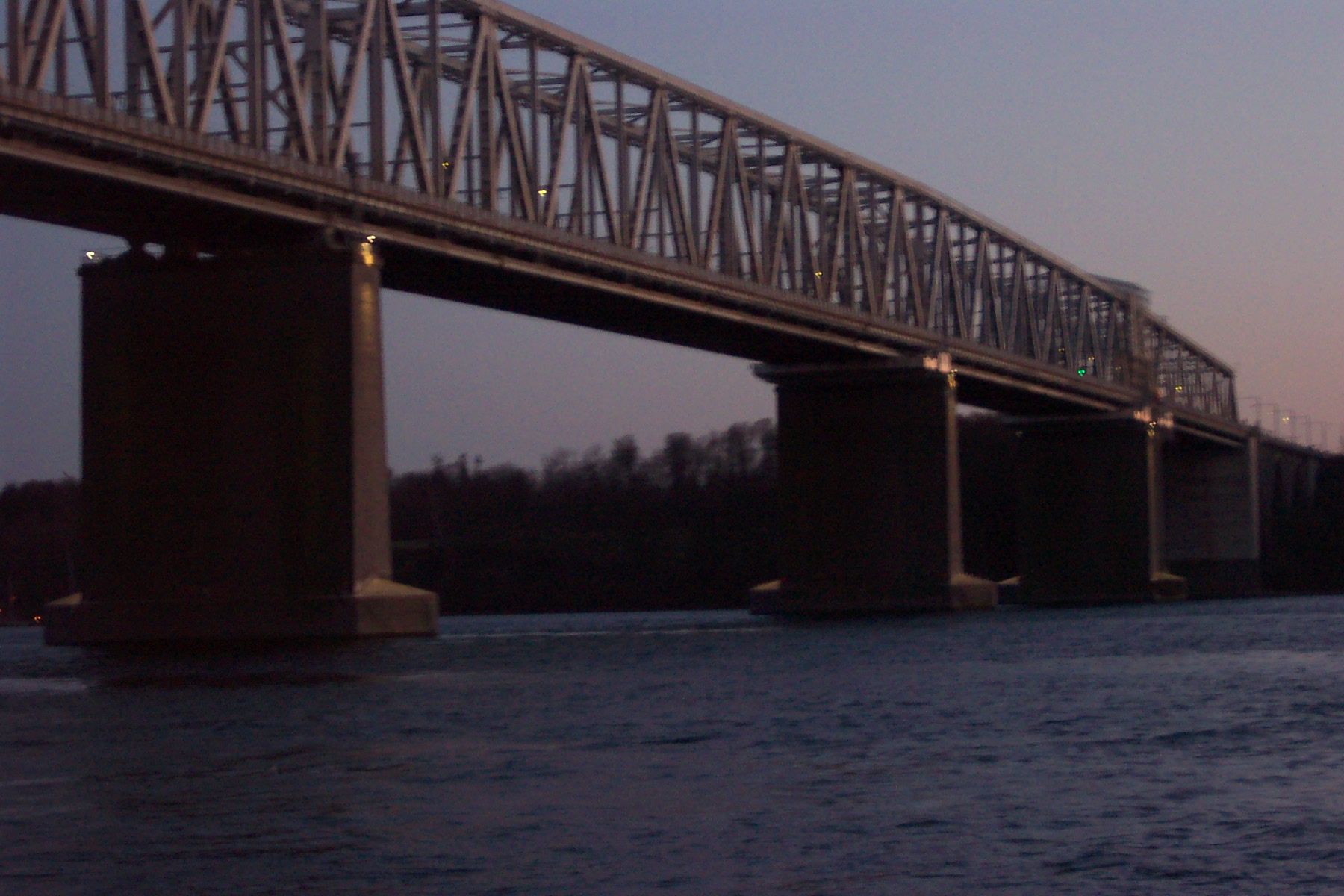
From the border, the line runs north through southern Jutland to Fredericia, then turns east over the Little Belt to the island of Funen. The railway crosses on the old Little Belt Bridge, a steel truss bridge from the 1930s, with water far below. A newer road bridge stands further along the strait.
i
Photo by Ævar Arnfjörð Bjarmason · CC BY-SA 3.0
This is the slower half of the route, and the quieter one. Southern Jutland is farm country, with red-brick villages, wind turbines on the skyline and long views over low fields to the sea. Fredericia, a fortified town at the narrowest point of the strait, is the junction where lines from the north of Jutland join the main line east. Many trains stop there only briefly, so stay aboard unless your ticket says otherwise.
On Funen the train stops at Odense, then runs to Nyborg and across the Great Belt to Zealand. This is a fixed link of bridge and tunnel, opened in the 1990s, and the train uses both: a low bridge across the western channel to the island of Sprogø, then a tunnel under the eastern channel. From Korsør on Zealand it is roughly an hour and a quarter more to Copenhagen.
D Change here forParis to Amsterdam, with a stop in AntwerpAbout 3½ hours directThe Fehmarn route, and why it is a question
For decades the classic way between Hamburg and Copenhagen was shorter and more direct: across the island of Fehmarn and the Fehmarn Sound Bridge to Puttgarden, then by sea across the Fehmarn Belt to Rødby on the Danish island of Lolland. Through trains used to roll onto the ferry itself.
That is no longer how it works. Through trains over the Fehmarn Belt were withdrawn while a fixed tunnel link between Fehmarn and Lolland is built, and the rail lines on both sides are being rebuilt for it. Today, through trains between Hamburg and Copenhagen go the long way round by Jutland. Foot passengers can still cross the belt by ferry with a combination of buses and local trains on each side, but the details change with the construction works.
When the tunnel opens, the journey should become much shorter. Until then, the Fehmarn route is a question to check, not a plan to rely on. The Fehmarn Belt crossing has more on what the sea route looks like today.
Until then, the Fehmarn route is a question to check, not a plan to rely on.
Copenhagen Central
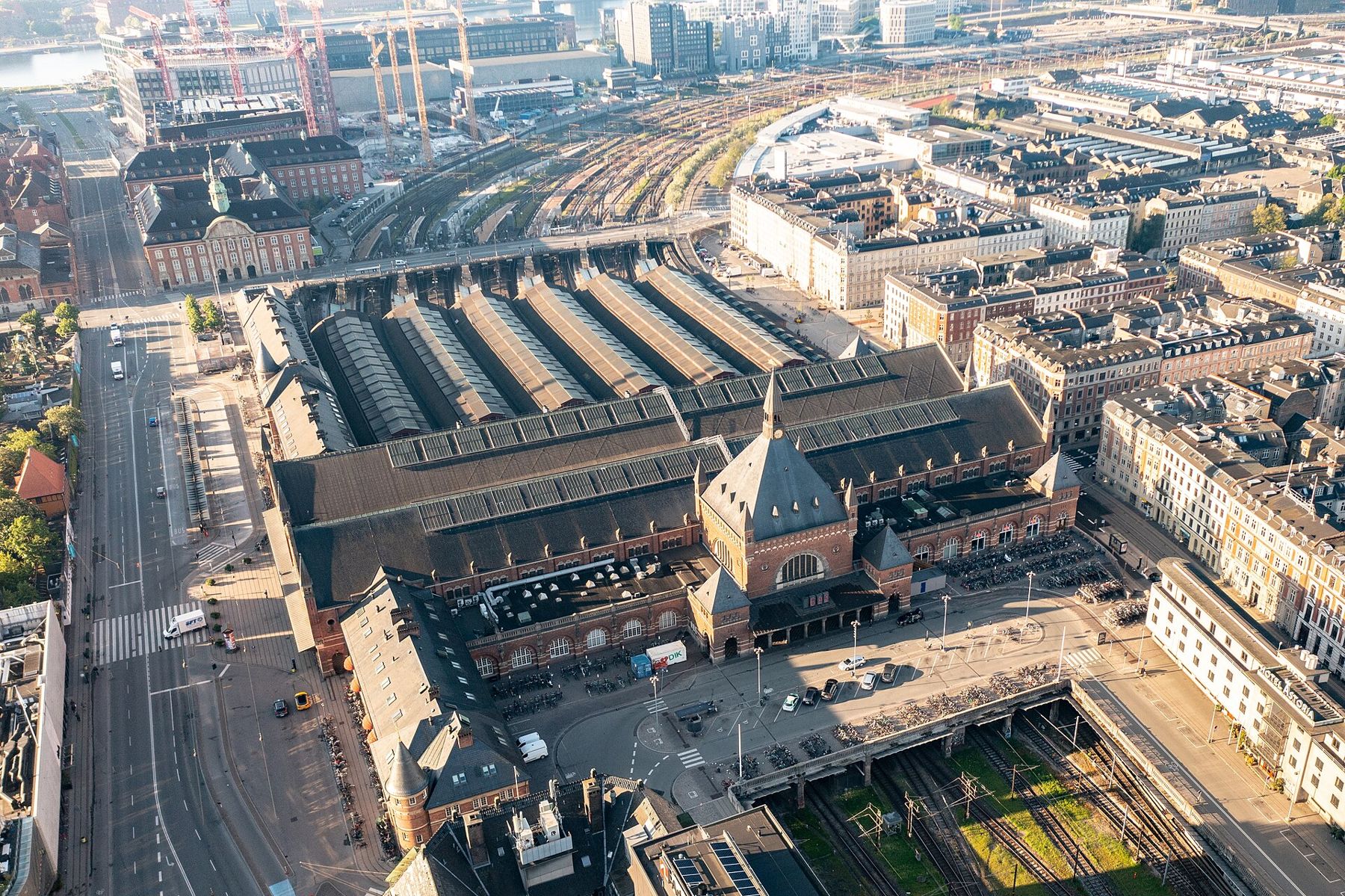
Copenhagen Central Station, the Hovedbanegård, is a red-brick station from the early twentieth century, with a long timber-vaulted hall over the platforms. It stands in the city centre, a short walk from the city hall square. Trains to Sweden across the Øresund leave from here, so this is also where Line E north towards Norway begins.
i
Photo by European Commission · CC BY 4.0
How to make the day work
Line C is long enough that the small things add up.
- Cross-border trains in this corridor are often late, especially on the German section. Build in an hour at Hamburg at least, and consider a night there.
- Through tickets between the Netherlands, Germany and Denmark can be bought, and they protect your onward connection if one train runs late. Separate tickets usually do not. Read about through tickets and missed connections before you choose.
- Seat reservations are optional on most of these trains but sensible on busy days, especially northbound on summer Fridays.
- Engineering works close sections of track in Germany and Denmark regularly, especially at weekends, and replacement buses can add hours. Check the current timetables of NS, DB and DSB for your date.
It also helps to know where the food is. Not every train on Line C carries a restaurant or trolley, and the Danish section in particular often has little or nothing on board. Buy something at Hamburg, where the station has more choice than most, and keep water with you for the whole day.
Done in one day, Line C is an endurance test with good scenery at the end. Done in two, with Hamburg in the middle, it is one of the better overland journeys in northern Europe: a slow drift from the Dutch canals to the Danish straits, without once leaving the ground.