Paris to Zürich through Basel
Line F leaves the most ornate station in Paris, crosses Burgundy and the Franche-Comté at speed, and enters Switzerland at Basel. A little over four hours, mostly through quiet, rolling country.
i
Photo by Oliylkaeng · CC BY 4.0
Line F is the shortest of the long-distance lines on this map and the one that changes least along the way. Direct high-speed trains, run jointly by SNCF and SBB, leave Paris Gare de Lyon for Zürich several times a day and take a little over four hours. You do not have to change. But the line passes through a station that is really two stations in two countries under one roof, and then follows the Rhine for a while, and both are worth knowing about.
The clock tower at Gare de Lyon
Gare de Lyon is the Paris terminus for the south and southeast of France, and for Switzerland and Italy. Its front, built for the 1900 Exposition Universelle, is topped by a tall clock tower that is one of the landmarks of the twelfth arrondissement. Inside, two large halls hold the platforms, lettered and numbered in two groups, and the departure boards announce the platform for each train only a short time before it leaves.
Trains for Switzerland are usually announced in the same part of the station as other high-speed services, and boarding can close a couple of minutes before departure. Find your coach number on your ticket and the platform sector board, which shows where each coach will stop, before the train arrives.
The station is well connected to the rest of Paris. Metro lines and the RER stop beneath it, and Gare d'Austerlitz lies just across the Seine. If you are arriving in Paris from London or the north, you will come into Gare du Nord instead, and the crossing between the two stations by metro or RER takes roughly half an hour with luggage; allow more at busy times. For travellers coming from Brussels or Amsterdam on Line D, that crossing is the only real change between the two lines.
East across Burgundy at speed
Leaving Paris, the train runs southeast on the high-speed line towards Lyon, through the farmland and forests of the Yonne and into Burgundy. Near Dijon it turns east onto a newer high-speed line, built to link the Rhine and the Rhône valleys, which carries it across the Franche-Comté towards Besançon and Belfort. The country here is rolling and green, with wooded hills, small rivers and villages clustered around church spires.
This is not a line of great set pieces. There are no mountains in view for most of the journey, and the high-speed track keeps to cuttings and embankments that hide much of the landscape. It is, though, a restful run: smooth, quiet and steady, the kind of stretch where a book or a long lunch fits naturally. The Jura begins to show on the horizon to the south as you approach Belfort, a first hint of the mountains ahead.
Depending on the train, there may be stops at Dijon, at Mulhouse, at one of the high-speed stations built outside Besançon and Belfort, or at none of them. Check the stopping pattern of your train if you need to get on or off along the way.
East of Belfort, the high-speed line ends and the train joins the older line through southern Alsace. Mulhouse is the last large French town before the border. From here, the train runs through the flat country of the Sundgau, between the Vosges and the Jura, towards Basel.
C Change here forAmsterdam to Copenhagen, with or without the seaA long day, about twelve hoursBasel SBB, where France and Switzerland share a building
Basel SBB, the city's main station, is a large Swiss station with an unusual neighbour. At its western end there is a French section, with its own platforms for French regional trains from Mulhouse and Strasbourg, separated from the Swiss part of the station by a customs passage. For many years this part was run as a separate French station, and it still feels a little like one: different signs, different trains, a border inside a building.
Direct trains from Paris to Zürich do not use the French platforms; they arrive on the Swiss side and continue after a short stop. If you are changing at Basel, though, from a French regional train to a Swiss one, you will walk from one section to the other through the customs passage. Switzerland is in the Schengen area but outside the EU customs union, so customs officers may check goods even when nobody looks at passports.
Basel is also a city with a second main station, Basel Badischer Bahnhof, which belongs to the German railway network although it stands on Swiss soil. Basel's three railways explains how they fit together, and how the trams link them.
Direct trains from Paris to Zürich do not use the French platforms; they arrive on the Swiss side and continue after a short stop.
Along the Rhine to Zürich
From Basel the train runs east, and for a stretch the line follows the south bank of the Rhine past Rheinfelden and Stein-Säckingen. On the far bank is Germany. The river here is wide, green and fast, with old bridges at the towns and power stations along its course.
Beyond Stein-Säckingen the line turns away from the river, passes under the Bözberg and comes down to Brugg, where the Aare, the Reuss and the Limmat meet. The last part of the run follows the Limmat valley through Baden and the outskirts of Zürich. The whole section from Basel takes roughly an hour.
i
Photo by David Kernan · CC BY 4.0
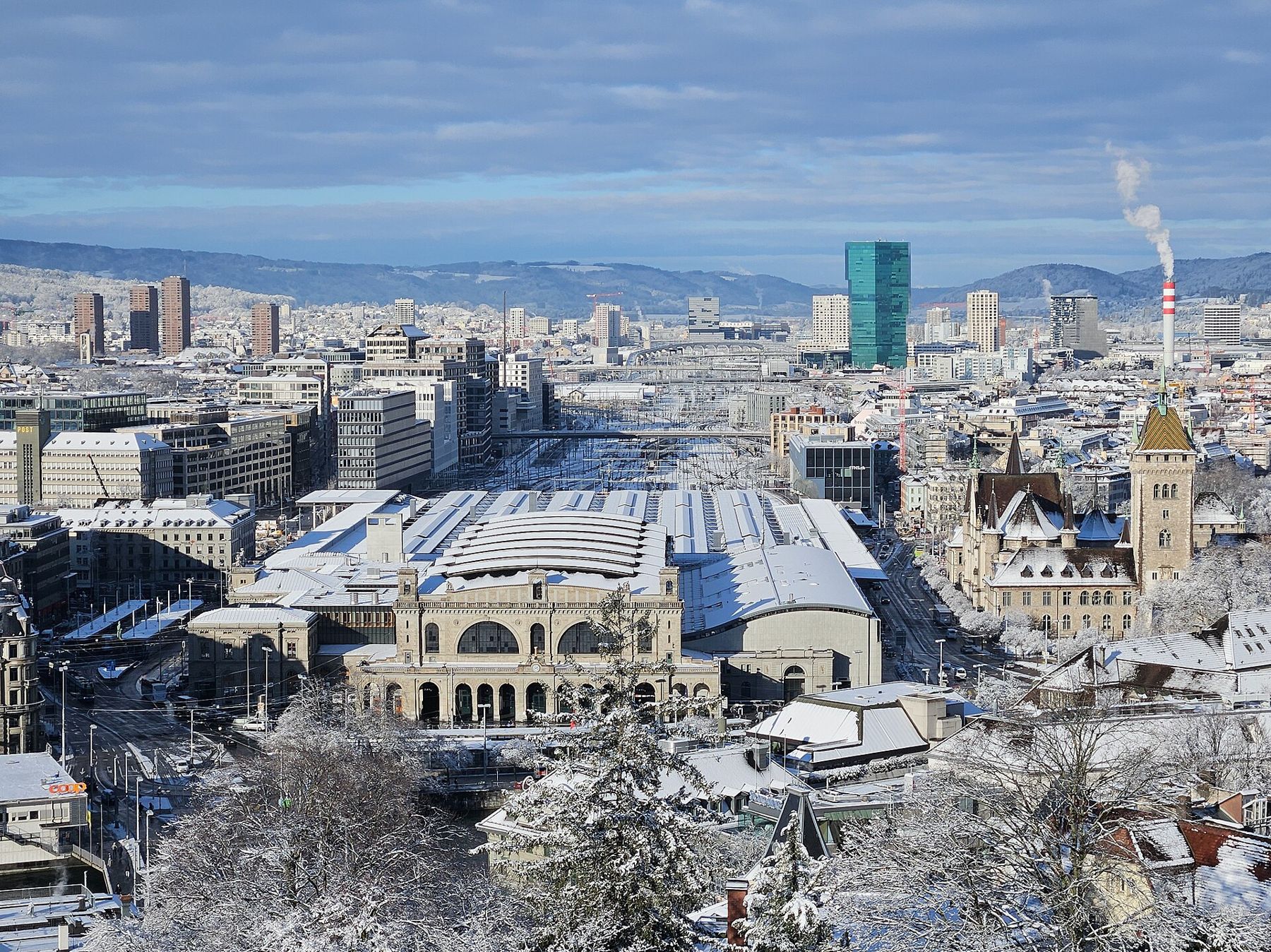
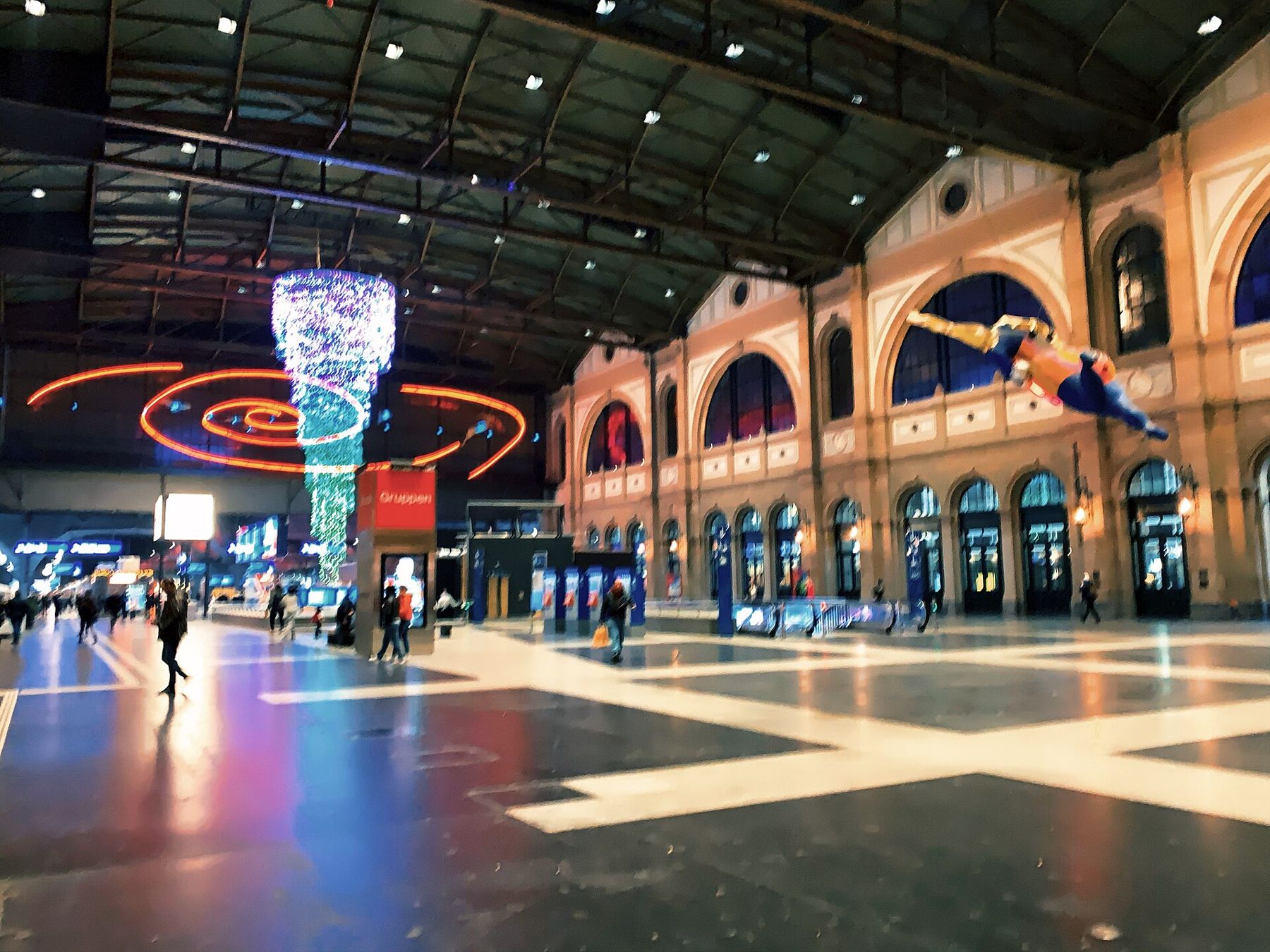
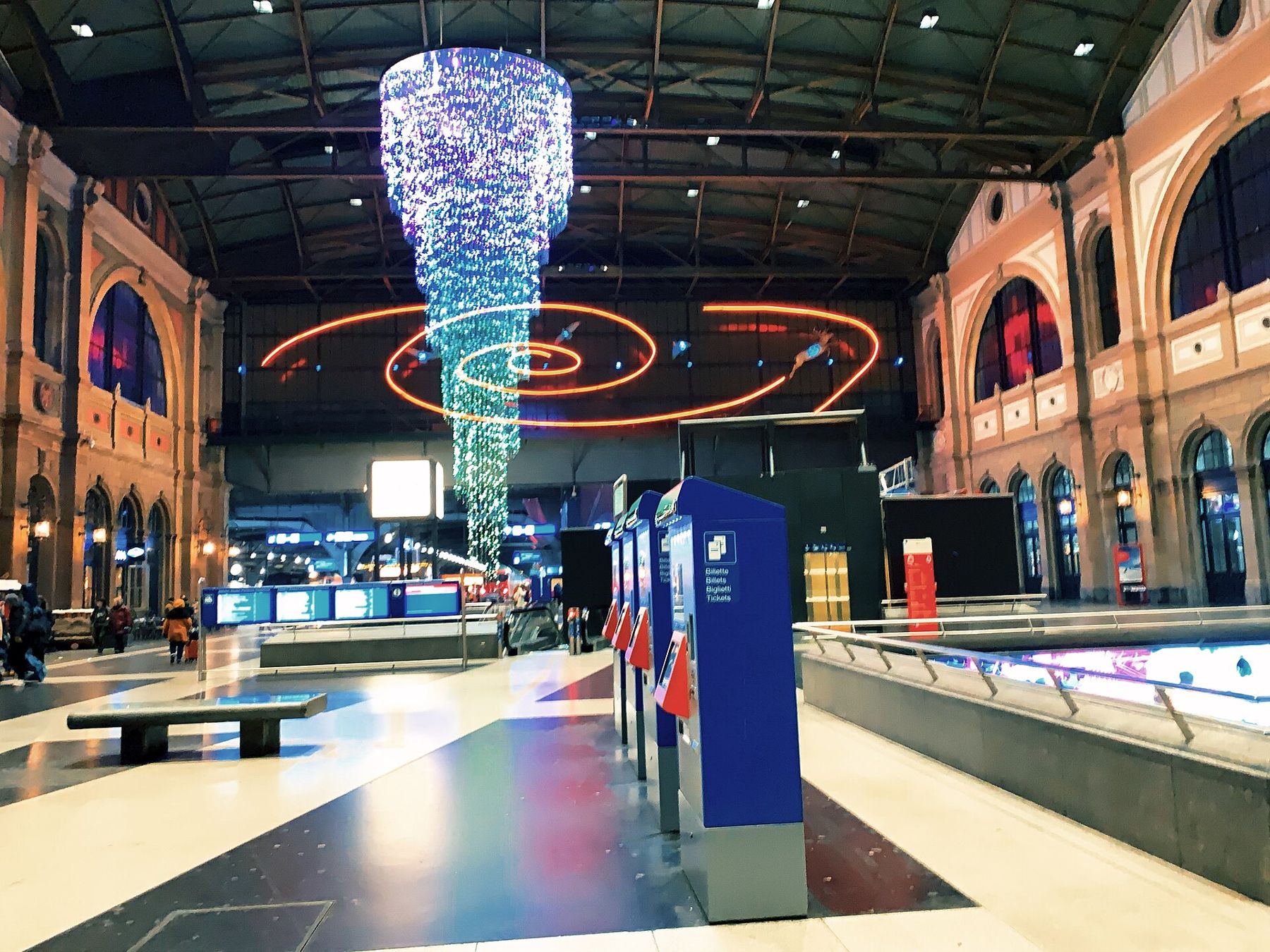
Zürich Hauptbahnhof's great hall
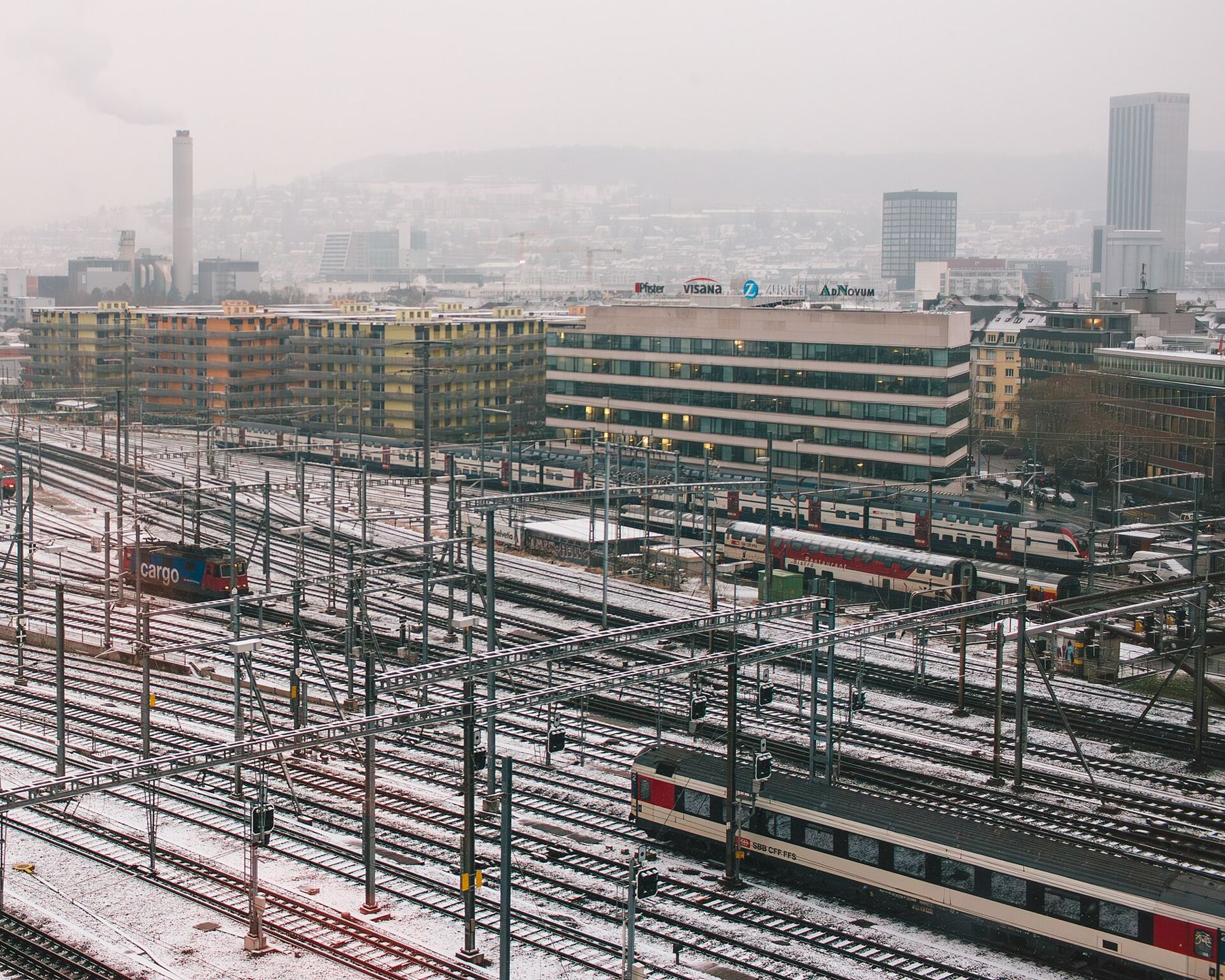
Zürich Hauptbahnhof is one of the busiest stations in Europe and the hub of the Swiss network. The main building, from the 1870s, holds a great hall that once covered the platforms and is now an open space used for markets and events, with the trains beyond it under a newer roof. Beneath the streets, further levels hold through platforms for suburban and long-distance trains.
i
Photo by Ank Kumar · CC BY-SA 4.0
i
Photo by Ank Kumar · CC BY-SA 4.0
From the main entrance, the Bahnhofstrasse leads south towards the lake, and the old town lies just across the Limmat. Trams leave from the square in front of the station. If you are continuing south, Zürich is where Line A to Milan under the Gotthard begins.
Tickets, timing and francs on Line F
- Direct trains between Paris and Zürich run several times a day but not every hour. Check the current timetables of SNCF and SBB for your date.
- Seat reservations are included in high-speed tickets on this route. Fares rise as trains fill.
- If you miss the direct train, an alternative is to travel to Basel or Mulhouse and change. On separate tickets, a delay on the first leg is not the railway's responsibility; see through tickets and missed connections.
- Food is usually available on board, but carry water.
- Switzerland uses its own currency. Cards are widely accepted, but a few francs are useful.
Line F is the gentle way into the Alps from Paris: a morning of rolling country, an hour along a great river, and an arrival in a station that is part of the city's daily life rather than set apart from it.