Tirano: two stations, one square
At the top of the Valtellina, the Italian regional line ends a few steps from the Swiss narrow-gauge station, and the Bernina trains roll out through the town's streets.
i
Photo by Maurizio Moro5153 · CC BY-SA 4.0
Tirano is a small town at the head of the Valtellina, close to the Swiss border, and for most travellers it is a place passed through in under an hour. It deserves a little more attention than that. Two railways meet here that were never designed to meet: the Italian standard-gauge line climbing up the valley from Lake Como and Milan, and the metre-gauge Bernina line of the Rhaetian Railway, which comes down from the Engadine over one of the highest rail crossings in the Alps. They do not share tracks, platforms or ticket offices. They share a square.
Two railways that never join
The Italian station is the terminus of the regional line from Milan. Trains arrive here and go no further; the buffers at the end of the platforms mark the end of the Italian network in this valley. The Swiss station stands next door, a separate building with its own platforms, its own staff and its own timetable boards. The gauges are different, so no carriage can pass from one to the other, and the two systems sell their tickets separately.
That makes the change simple to describe and easy to underestimate. You leave the Italian train, walk out of its station, turn a few steps along the square, and enter the Swiss one. The distance is short enough that you can see one entrance from the other. What takes time is everything else: finding the right counter or machine, buying a ticket if you do not already hold one, and, in summer, joining the queue of people with large bags who arrived on the same train as you.
Buying the Swiss half of the journey
If you are travelling from Milan to St. Moritz or beyond, the Italian part and the Swiss part are often sold as separate tickets. Some through fares exist, and some rail passes cover both, but you should never assume the Italian ticket carries you onto the Bernina line. Check what your ticket says before you reach Tirano.
The ordinary regional trains of the Rhaetian Railway on the Bernina line do not need a reservation. The panoramic trains that run over the same tracks are a different matter: they carry a supplement and require a seat reservation, and in the summer season those seats can be gone well before the day of travel. The ordinary trains take the same route over the same pass at much the same pace, with windows that open, and many travellers prefer them for exactly that reason. Read more about the whole route in the line from Milan over the Bernina.
Prices on the Swiss side are in Swiss francs, even though Tirano is in Italy. Check current payment options at the station before you rely on one.
The border a few minutes up the line
The Swiss station sits on Italian soil, and the international border lies a short way north, beyond the town, near Campocologno. Switzerland is in the Schengen area, so there is normally no passport control on the train, but it is outside the EU customs union, and customs officers may check travellers and goods at the border. Carry your passport or identity card as you would on any cross-border trip, and keep to the customs allowances if you are carrying food, alcohol or anything bought in quantity. Rules and checks change; look at the current guidance before you travel.
B Change here forMilan to St. Moritz, over the BerninaAbout 5 to 6 hoursA railway that runs down the street
The first thing the Bernina line does when it leaves Tirano is surprise people. Instead of curving away on its own embankment, the train rolls out of the station and along the streets of the town, sharing the road with traffic, before running past the square beside the basilica and heading up the valley. Cars stop for it, and it moves slowly, more like a tram than a mountain railway.
i
Photo by Leonhard Lenz · CC0
If you have a spare hour, walk this short stretch on foot rather than watching it from a carriage. You can follow the track from the station to the basilica square in a few minutes, and you see how tightly the town has been built around the line. After the town, the train starts its long climb through Brusio, round the stone spiral viaduct, and on towards Poschiavo and the pass.
The basilica of the Madonna di Tirano
i
Photo by Leonhard Lenz · CC0
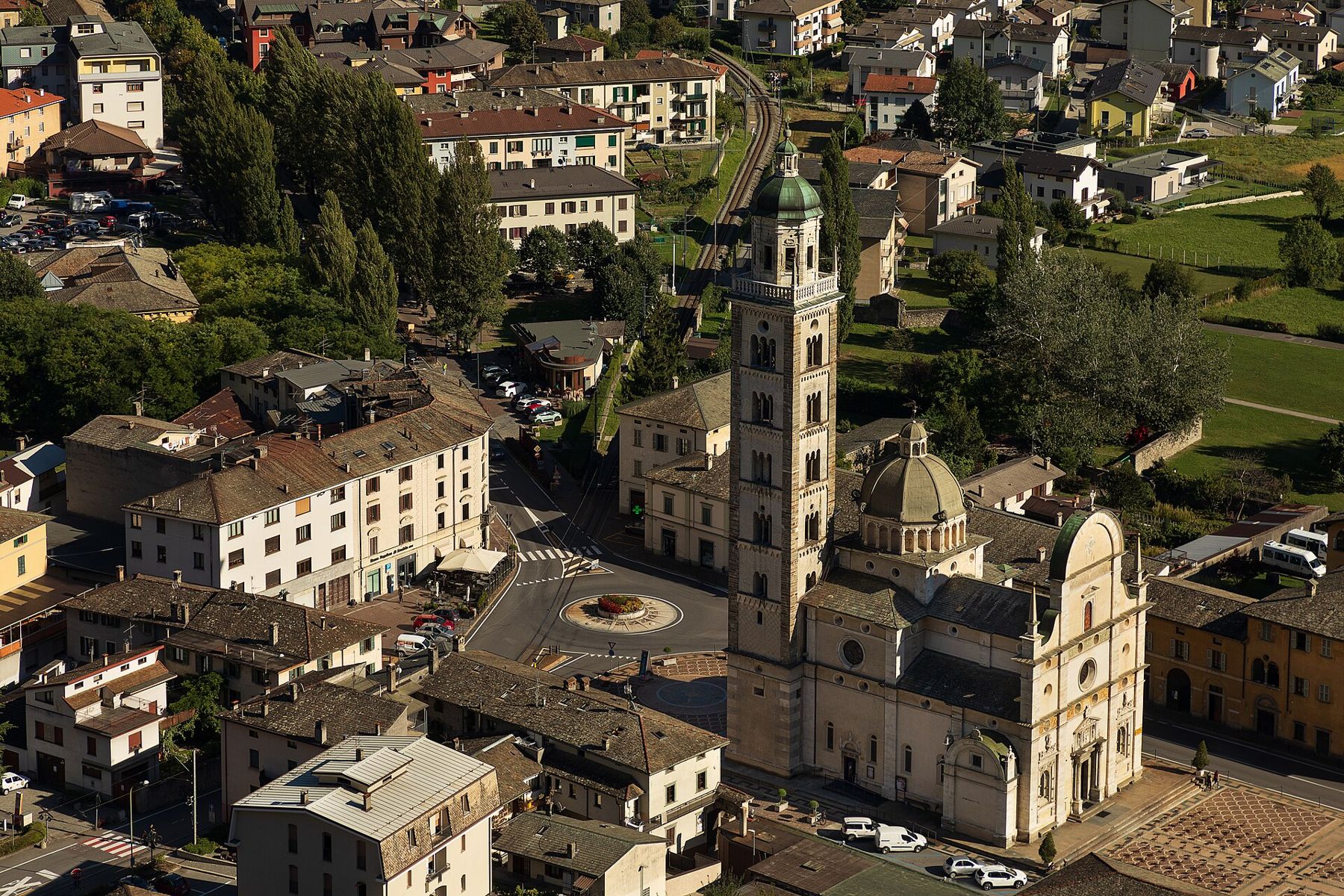
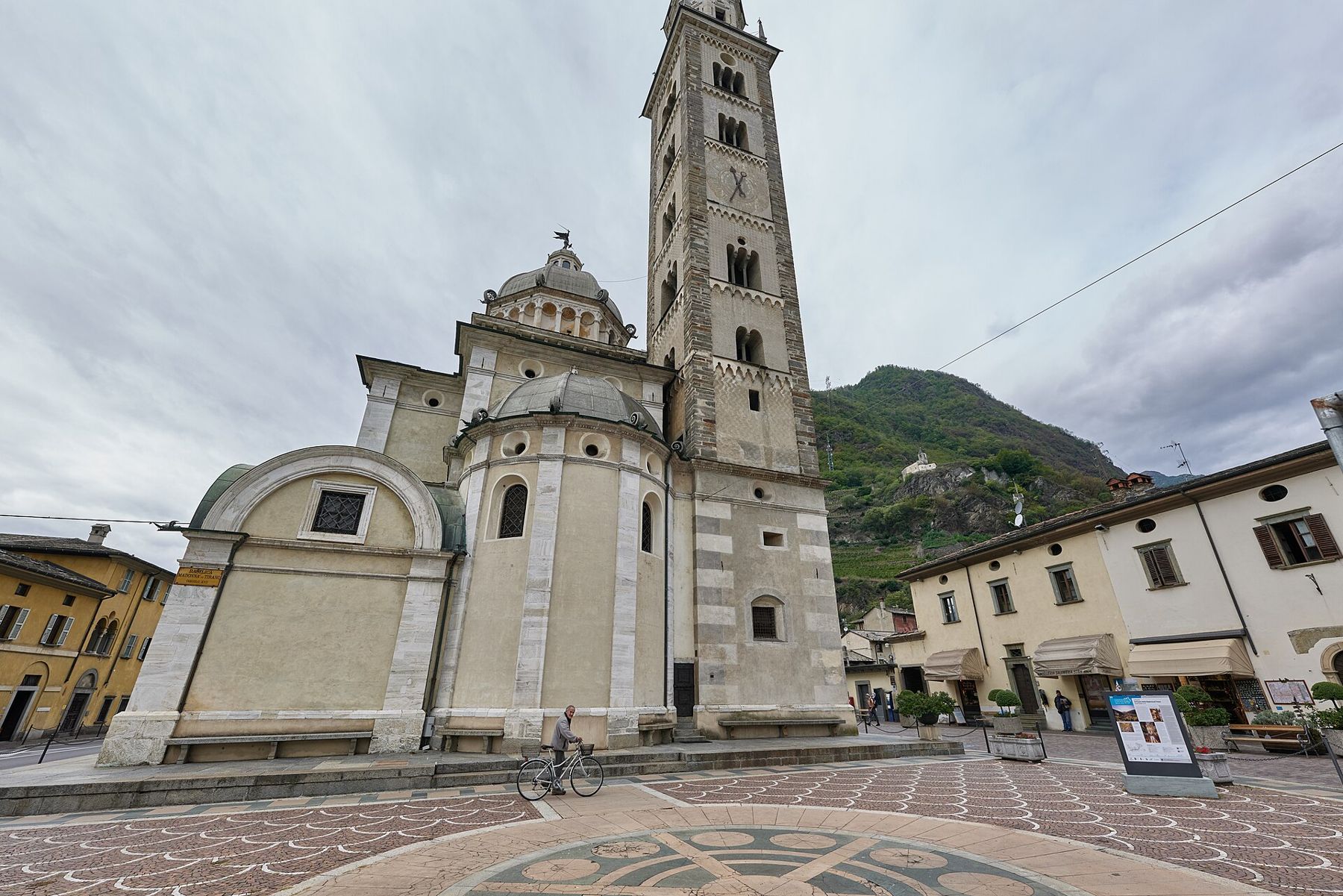
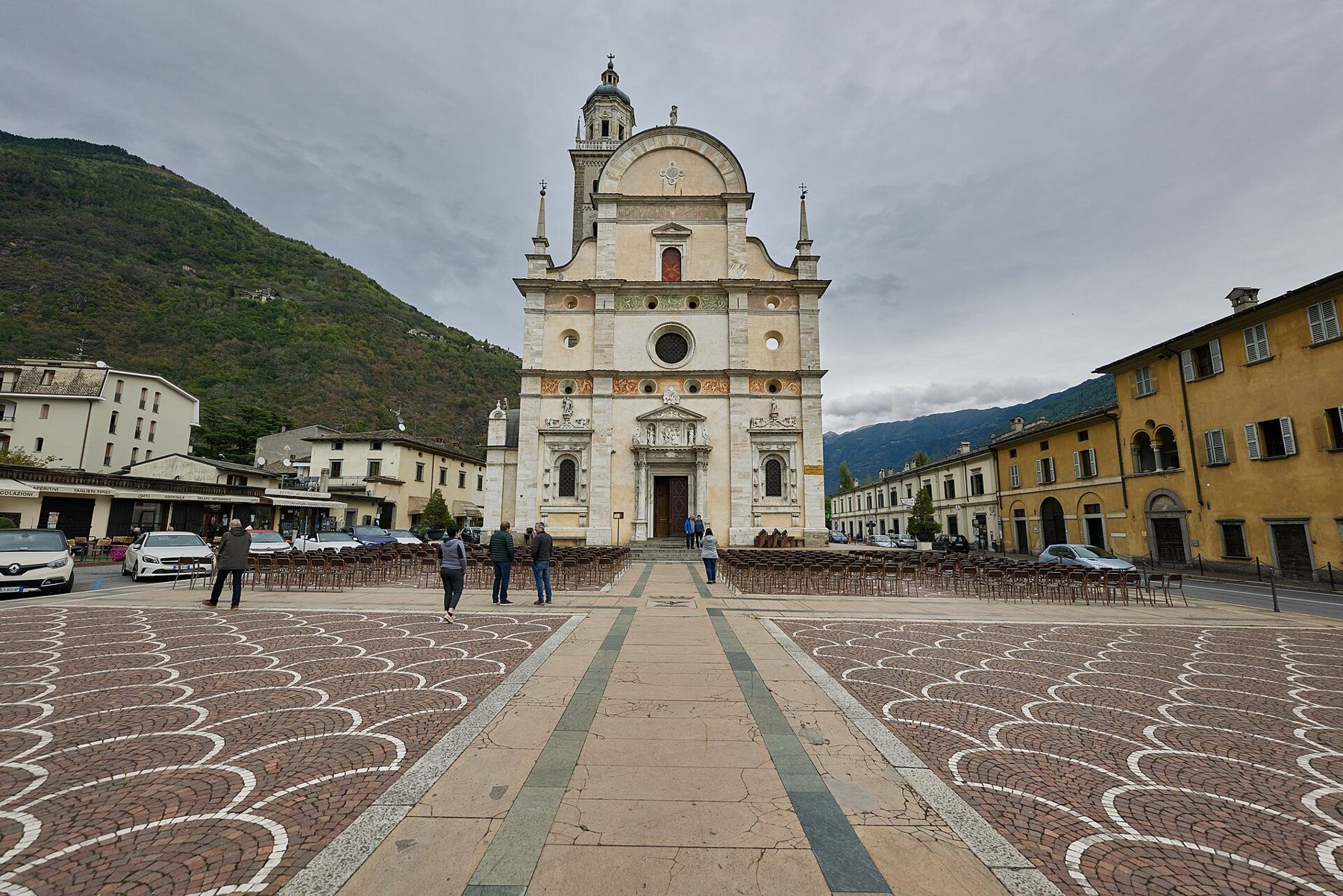
The large church on the edge of town, on the road towards the border, is the basilica of the Madonna di Tirano, a pilgrimage church begun in the early sixteenth century on the spot where a Marian apparition was reported in 1504. It is far grander than a town of this size would suggest: a broad Renaissance front, a richly decorated interior with carved wood and painted ceilings, and a famously ornate carved organ. It remains a working church, so avoid services if you are only looking round.
From the stations, the walk is short and flat, and it follows the same route as the Bernina track for much of the way. This is the obvious way to use a wait between trains: the basilica, the square outside it, and a slow walk back through the old streets.
An hour or a night in Tirano
Most travellers arrive from Milan and leave for Switzerland the same day. The regional journey up from Milan takes about two and a half hours, much of it beside Lake Como and then along the flat floor of the Valtellina between vineyards and terraced slopes. The Bernina line from Tirano to St. Moritz takes roughly the same again. Done in one go, that is a long but very manageable day, best started in the morning so that the high part of the Bernina crossing happens in full daylight.
Staying a night in Tirano changes the rhythm. You can take an early train up the Bernina before the summer crowds, and the terraced vineyards of the Valtellina, on the valley's sunny side, reward a slower look. In winter, when snow lies on the Bernina pass, an overnight stop also gives you the chance to take the first train up and see the high plateau before the light goes flat.
If you are coming the other way, from St. Moritz, the same rules apply in reverse. Allow time to find the Italian station's ticket machines, and remember that the regional trains to Milan run less often in the evening. Check the current timetable before you plan a late departure.
What to watch for at the change
- Arrival delays on the Italian side are common enough that a tight connection is a gamble. Leave a comfortable margin, and treat an hour as normal rather than generous in summer.
- Read the departure boards in both stations. The Swiss station shows which trains need a reservation and which do not.
- Luggage is your own affair here. There are no porters between the stations, and the square has a few uneven stretches. A bag on wheels manages, but slowly.
- Weather on the pass can be very different from the warm valley floor. Keep a jacket in your hand luggage, not in the case on the rack.
For the station at the other end of the Italian line, see Milano Centrale, and for the broader question of separate tickets on one journey, see through tickets and separate tickets.