Milano Centrale, the station as a destination
Few stations are built to impress the way Milan's main station is. A guide to its halls, its platforms, the trains north to the mountains and the city a few metro stops away.
i
Photo by Steffen Schmitz · CC BY-SA 4.0
Milano Centrale is not a station you slip through unnoticed. It is enormous, it is built of stone, and it was designed to impress anyone who arrived. Opened in 1931 after a long and interrupted construction, it gathers Milan's long-distance and many of its regional trains under a single great roof. For travellers on the line from Zürich, the trains from France, and the regional line up to Tirano and the Bernina, it is the place where Italy begins and where most onward journeys start.
A building made to be looked at
The station was designed by Ulisse Stacchini, whose plan won a competition held before the First World War. The war and the years after it slowed the work, and the design grew heavier and more monumental as it went. What stands today is a mixture of styles that does not fit neatly into any of them: there is Art Nouveau in some of the detail, classical grandeur in the scale, and the monumental taste of the late 1920s in the stone and statuary. Critics have argued about it for nearly a century. Few people forget it.
The façade is long and pale, with deep arches and sculpture on almost every surface. Behind it, a sequence of halls leads up towards the platforms, each bigger than you expect. At the top, the train shed spreads its iron and glass arches over the tracks in several wide spans. The best way to see the building is to give yourself time before your train and walk it slowly, from the street to the platform ends.
From the street to the platforms
The tracks at Centrale sit on a raised level, well above the street. You enter at ground level, rise through the halls by escalators, moving walkways or stairs, and arrive at the long concourse that runs across the ends of the platforms. Everything else in the station hangs off this route: ticket machines and offices at the lower levels, shops and food along the galleries, the departure boards above the concourse.
The distances are long. With luggage, it can take ten minutes or more to get from the metro to a platform, and longer if a lift is busy. Access to the platforms is controlled, and you may be asked to show a valid ticket at the gates before you can reach your train. Have it ready, on paper or on your phone, to avoid holding up the queue.
Platform numbers for long-distance trains are often shown only a short time before departure. Stand where you can see the main boards, and do not drift too far into the galleries in the last quarter of an hour.
Where the Tirano trains leave
The regional trains that run up the Valtellina to Tirano leave from Centrale. They are ordinary Italian regional trains, unreserved, and they make a long, steady run along the eastern shore of Lake Como before turning into the valley. The journey takes about two and a half hours. At Tirano you change to the Rhaetian Railway for the Bernina line. See Tirano's two stations for the change itself, and the full route in Milan to St. Moritz over the Bernina.
A Change here forZürich to Milan, under the GotthardAbout 3½ hoursRegional tickets are not tied to a specific train, so check the rules for validating paper tickets before you board: an unvalidated regional ticket can bring a fine on Italian trains. The rules for digital tickets differ. Read what your ticket says.
Trains through the Gotthard from Zürich and Lugano also arrive here, as do some high-speed services from elsewhere in Italy and the trains from France. The line from Zürich runs under the Gotthard and past the lakes.
The Binario 21 memorial
Beneath the station is the Memoriale della Shoah. During the German occupation of Italy, Jewish people and others were loaded onto trains from a hidden track below the main platforms, known as Binario 21, and sent to the camps. The memorial preserves the place and tells their story. It is not something to fit into a gap between trains; if you plan to visit, give it its own time and check the current opening days first.
Milan's centre in a few hours
i
Photo by Roberto Monti · CC BY-SA 4.0
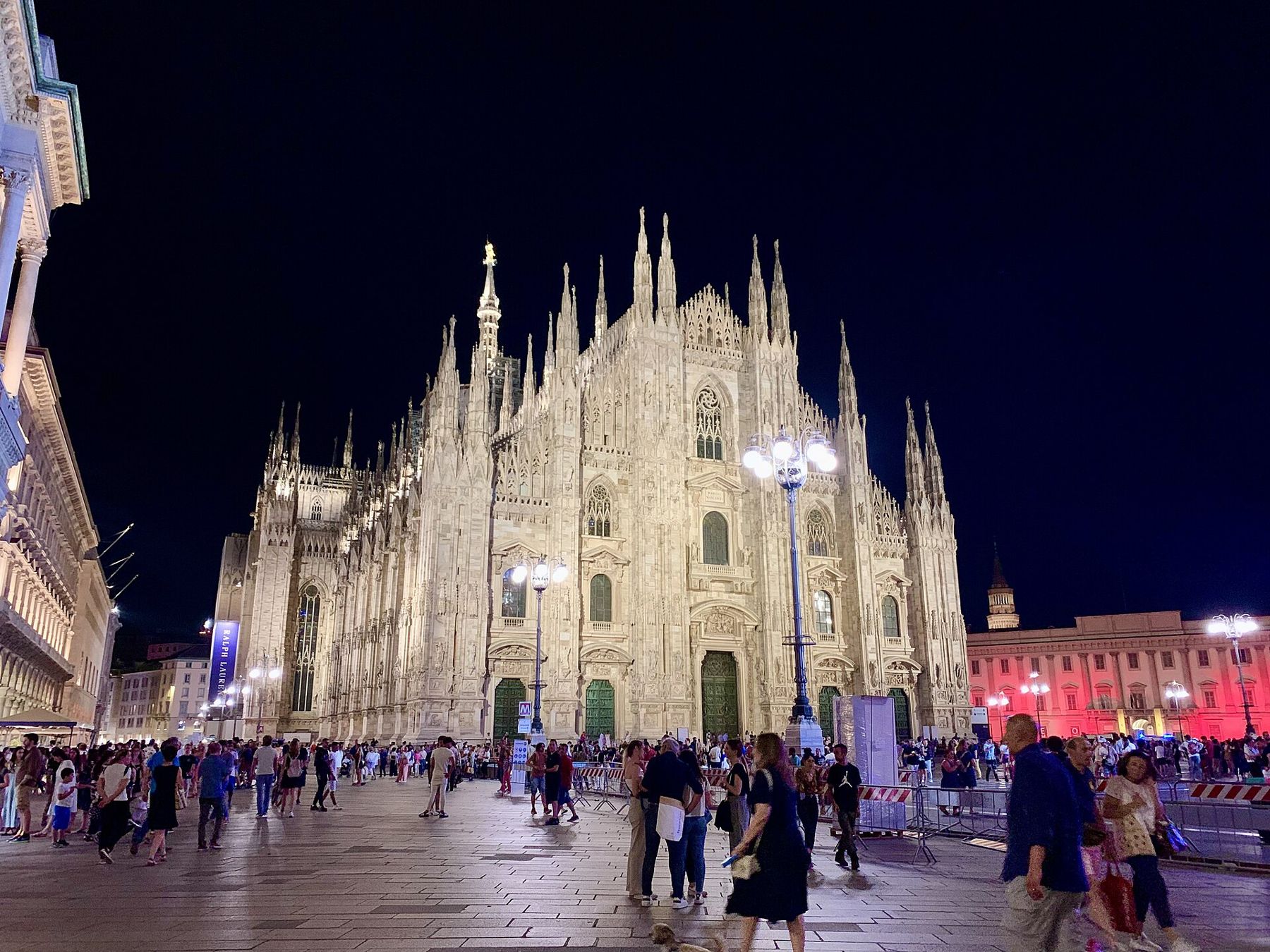
If you have a few hours between trains, the centre of Milan is within easy reach. Two metro lines stop beneath the station: the green M2 and the yellow M3. The yellow line runs directly to Duomo in a few stops, and you come up into the cathedral square. The cathedral is the obvious first sight: its marble front, its forest of spires, and, if you have time and a ticket, the roof terraces, where you can walk among the pinnacles above the city.
Beside the cathedral square, the Galleria Vittorio Emanuele II is a nineteenth-century glass-roofed arcade linking the Duomo with the Piazza della Scala and the opera house. Even with a short stop you can walk through it, look up at the dome, and come back the same way.
A sensible plan for a short break is the metro to the Duomo, the cathedral, the Galleria and a walk back towards the station, or the metro back, leaving yourself a full half-hour at Centrale before your train. The station has a left-luggage service, which makes this much easier with heavy bags; check where it is and its current hours.
Small comforts for long legs
- Buy metro tickets before you go underground, and keep them until you leave the system: exit gates may ask for them.
- Keep bags close in the busy halls and on the escalators.
- If your train is international, check whether it needs a reservation. Some do, some do not, and the rules have changed in recent years.
- Give yourself a margin for a missed connection. Read through tickets and missed connections before you rely on a short change in Milan.
Centrale can be crowded and loud and slow to cross. It is also one of the few stations in Europe worth arriving early for on purpose.